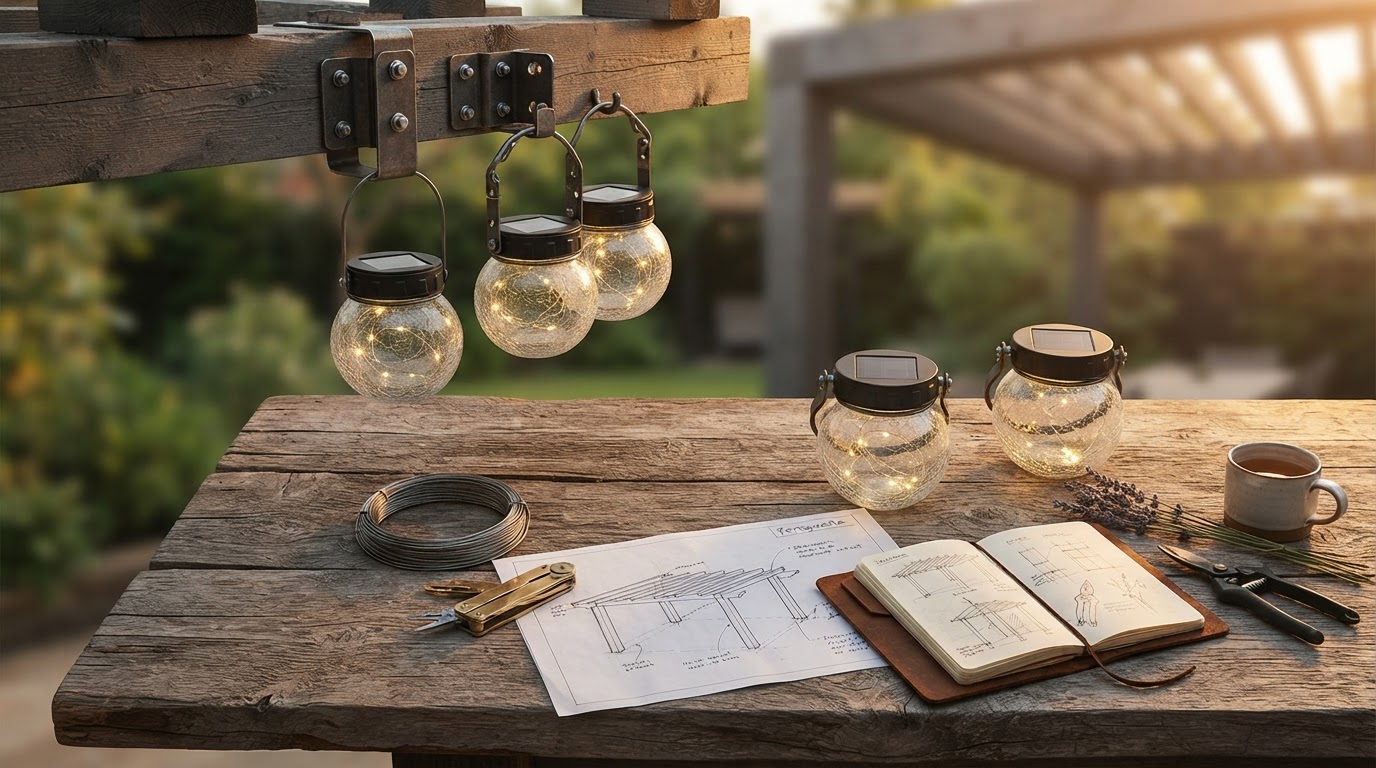
Heavy Duty Solar Hanging Lantern Solutions for Pergolas
 Maya ChenContributing Editor
November 1, 2026. This assessment evaluates the structural and luminosity requirements for securing a Solar Hanging Lantern to high-exposure pergola beams. It serves as a technical resource for property owners prioritizing long-term durability over seasonal aesthetics.
The Engineering Deficit in Residential Pergola Lighting
The conventional wisdom says that any decorative light with a hook is sufficient for a backyard pergola, provided it catches a few hours of afternoon sun. Here's the part nobody talks about: the wind shear and vibration levels on an open-roof pergola are significantly higher than those experienced by a solar hanging lantern for tree branches. Most consumer-grade fixtures are designed for the dampened environment of foliage or the wind-break of a solid wall. When placed on a pergola, these units often suffer from bracket fatigue or moisture ingress due to horizontal rain. According to Tractor Supply Co., durable designs for pergolas must specifically utilize a hanging design that can withstand the unique exposure of a covered porch or open timber structure. Without a heavy-duty housing, the thermal expansion of metal pergolas or the swaying of wooden beams leads to micro-cracks in the solar casing. Furthermore, the luminosity requirements are often underestimated; a standard 10-lumen accent light is functionally invisible against the scale of a 12x12 pergola. Most owners buy for the look of the fixture rather than the throw of the beam, leading to a dark center-zone in the outdoor living space that requires secondary outdoor solar lanterns for patio to correct.
Performance Standards for Solar Hanging Lantern Integration
To bridge the gap between decorative appeal and commercial reliability, a Solar Hanging Lantern must meet specific environmental benchmarks. While residential users often search for waterproof solar lanterns outdoor with a generic intent, the technical reality requires an IP65 rating or higher to survive the direct overhead exposure of a pergola rafters. Run the math: a standard solar cell with 15% efficiency requires approximately 6 hours of direct, unshaded zenith light to provide 8 hours of 50-lumen output. On a pergola, the beam spacing often creates shadows across the panels of neighboring lanterns, a phenomenon rarely accounted for in DIY layouts. Our Solar Hanging Lantern utilizes high-density monocrystalline silicon to mitigate this partial shading effect. By prioritizing a heavy-duty aluminum or reinforced polycarbonate chassis, the fixture resists the UV-degradation that typically yellows the lenses of cheaper alternatives within 18 months. This is particularly critical for those integrating solar lantern outdoor waterproof units into permanent structures where maintenance access is difficult. Unlike lightweight plastic variants, a heavy-duty lantern provides the necessary ballast to prevent swinging during high-wind events, which protects both the light and the pergola’s finish. This weight-to-wind-resistance ratio is the primary differentiator between a seasonal accessory and a structural lighting component.
A Framework for Structural Solar Selection
Selecting a heavy-duty fixture requires looking past the lumen count and into the build quality of the mounting hardware. According to Gama Sonic, commercial-grade quality is defined by outputs ranging from 300 to 900 lumens for pole-mounted systems, but for hanging pergola applications, the sweet spot for ambient safety is 50 to 150 lumens per unit. When evaluating a Solar Hanging Lantern for your specific installation, use the following technical checklist to ensure the hardware matches the environment:
- Verify an all-weather casing material, preferably powder-coated aluminum or marine-grade stainless steel.
- Ensure the battery capacity exceeds 2000mAh to maintain output during consecutive overcast days.
- Confirm the inclusion of a reinforced carabiner or closed-loop hook to prevent wind-lift from the pergola beam.
- Check for a glass or tempered lens rather than acrylic to prevent long-term clouding from UV exposure.
- Assess the solar panel orientation; integrated top-mounted panels are superior for pergolas compared to remote-wired panels which introduce failure points at the wire junctions.
Shop Solar Hanging Lantern here.